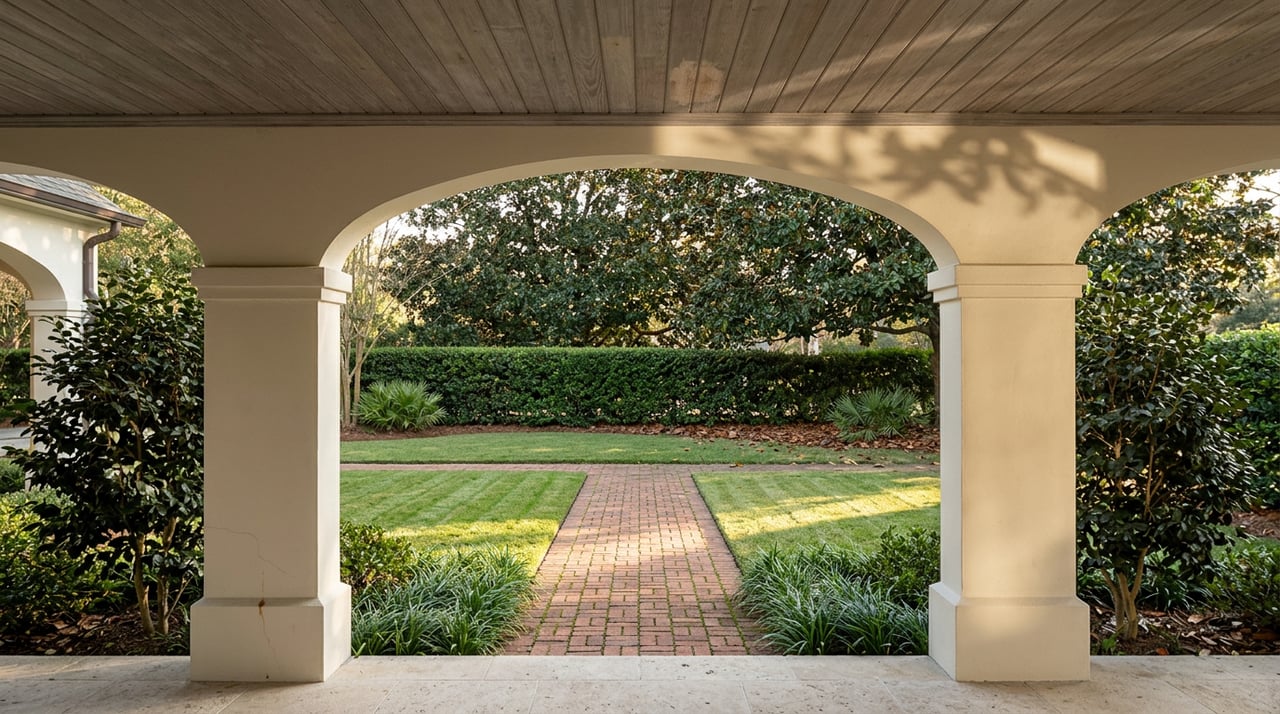
Historic Home Buying Rules in Laurel Park, Burns Court & Gillespie Park
August 27, 2026
August 27, 2026
A buyer walks through a 1920s bungalow on Oak Street, admires the original wood floors, and asks the obvious question: since this house sits inside a historic district, does that mean any renovation has to go through some board first? The agent nods vaguely. The buyer assumes the answer applies to the whole street, maybe the whole neighborhood. It doesn't.
That assumption is the single most common mix-up among people shopping Sarasota's downtown-adjacent neighborhoods, and it cuts both ways. Some buyers walk away from a beautiful Laurel Park cottage assuming they'll never be allowed to update the kitchen. Others buy a lot in Gillespie Park planning a full teardown, only to discover a design review process they didn't know existed. Both are working off the same faulty premise: that the phrase "historic district" describes one set of rules. It describes two, and which one applies to a given house depends on a fact that has nothing to do with the neighborhood's name.
The first system is the National Register of Historic Places, the federal list that gave Laurel Park its historic district status back in 2008. Williams Parker describes listing on the National Register as largely honorary. It recognizes that a building or a block of buildings matters historically, and it can open the door to restoration grants or tax incentives, but it does not by itself limit what an owner can do to the property. No federal reviewer is going to stop you from replacing a window because your street made the National Register decades ago.
The second system is local designation, and this is where actual restrictions live. When a city government separately designates a specific building or district, it creates the legal basis for a Certificate of Appropriateness, the permit that reviews exterior changes, additions, and demolitions against a set of design standards. In Sarasota, that review runs through the city's own Historic Preservation Board, not the National Park Service.
| National Register Listing | Local City Designation | |
|---|---|---|
| What it is | Federal recognition of historic significance | A city ordinance action naming a specific property or district |
| What it restricts | Nothing by itself | Exterior changes, additions, demolition |
| Who enforces it | No enforcement mechanism | City of Sarasota Historic Preservation Board |
| Applies automatically to every home in a National Register district? | Only if it is a "contributing" building; listing imposes no restrictions by itself | No, only to individually or locally designated resources |
Two homes on the same block in Laurel Park can sit on opposite sides of that second line. One might need board approval to swap out a front door. The one next to it might not need anything beyond a standard building permit. The National Register plaque tells you neither one.
The City of Sarasota's Historic Preservation Board is a seven-member volunteer body that generally meets the second Tuesday of each month at 3:00 p.m. in the City Commission Chambers. Its job is to review Certificate of Appropriateness applications for properties that carry local designation, recommend new historic designations to the City Commission, and weigh in on demolition permits for resources it has already flagged as significant.
That review process is separate from a mechanism specific to Laurel Park called the Overlay District.
For routine work like a window or door replacement with no landmark designation attached, the city's standard permitting timeline runs about two weeks. Add a Certificate of Appropriateness to that sequence and the timeline stretches to whatever the board's monthly meeting calendar allows, which is exactly the kind of scheduling detail a renovation budget needs to account for before closing, not after.
Laurel Park earned its National Register listing across roughly 50 acres and 314 buildings, 251 of which count as contributing structures to that historic designation. That's the number most buyers hear and assume applies uniformly.
The Laurel Park Neighborhood Association's own walking tour tells a narrower story. It identifies just 45 homes and structures in the entire district carrying an added City or National landmark designation, the tier that actually invites Certificate of Appropriateness review. Of those, only one, the Dr. Walter C. Kennedy House on Oak Street, holds both state and local landmark status, the highest level of protection anywhere in the neighborhood.
Run that math and a different picture emerges. Most of the roughly 250 contributing buildings in Laurel Park can be substantially renovated, and in some cases replaced, without landmark-level design review, even though every one of them sits inside a nationally recognized historic district. The label describes the neighborhood's story. It doesn't describe most individual owners' renovation ceiling.
This is why Laurel Park's brick-paved blocks show original 1920s cottages standing next to contemporary rebuilds, and why nearby Gillespie Park has become a genuine construction zone over the past decade, with original 1920s and 1950s houses giving way to full-lot rebuilds on several streets. Builders aren't ignoring history. They're reading the designation status of individual parcels correctly, and acting on the fact that most lots in these neighborhoods don't carry the local protections that would stop them.
The pattern holds outside downtown too. Sarasota's Newtown neighborhood earned its own National Register listing in April 2024, becoming the largest historic district in the city and the state's premier Black historic district, with more than 700 contributing resources. When that designation went through, District 1 City Commissioner Kyle Battie, a Newtown native, said it plainly: the designation carries no negative impact on residents' property rights. That's the honorary tier at work, on a much larger scale than Laurel Park.
The other downtown-adjacent districts sit at different points on this same spectrum. Burns Court, developed by the same Owen Burns who shaped Laurel Park, centers on a tight cluster of Mediterranean Revival buildings and the Burns Court Cinema, with a character residents actively protect through an engaged neighborhood association. Rosemary District has leaned into adaptive reuse and infill density rather than single-family cottage preservation, functioning more like an urban loft district. Towles Court, Sarasota's smallest historic pocket, is a compact grid of century-old cottages now doing double duty as galleries and studios. Each carries the National Register story. None of them applies restriction the same way house to house.
The only way to know what you're actually buying into is to ask about the address, not the neighborhood. Before falling for a listing photo, find out whether that specific parcel carries a local landmark designation separate from the National Register boundary. City of Sarasota planning and historic preservation staff can tell you directly, and most of the affected neighborhood associations, following Laurel Park's example, publish their own historic homes maps identifying which structures carry that added status.
If a renovation or rebuild is part of the plan, ask a second question: does this address fall under any overlay review process, like Laurel Park's, that exists apart from historic designation altogether. A house can clear the Certificate of Appropriateness question entirely and still need to go through a separate community design review before a shovel goes in the ground.
None of this means historic-core living comes cheap. Citywide, Sarasota's median sale price ran $588,000 over the three months ending June 2026, up 6.9 percent from the same period a year earlier, with homes selling at roughly $420 per square foot and typically spending about 75 days on the market before going under contract. Laurel Park listings in March 2026 carried a median price near $899,000, working out to roughly $535 per square foot, well above the citywide figure, and a longer median market time of 108 days.
That gap is the walkability premium, not a renovation tax. Buyers are paying for brick streets, a five-minute walk to Main Street, and proximity to Selby Gardens and the bayfront, the same lifestyle draw that shows up across Laurel Park, Burns Court, and Towles Court alike. The extra time on market likely reflects something else: buyers and their agents doing the address-by-address homework this piece just walked through, confirming designation status before committing, rather than assuming the neighborhood's reputation tells the whole story.
Can local historic designation qualify a property for a tax exemption? Sarasota County offers an ad valorem tax exemption program for owners completing qualifying rehabilitation work on locally registered properties, but that's an opt-in benefit, not an automatic cost.
Can I tear down a house in Laurel Park or Gillespie Park? It depends entirely on whether that specific lot carries a local designation, and in Laurel Park, whether the Overlay District's community design review applies to your rebuild plans. Sitting inside the National Register boundary is not, by itself, a demolition ban.
How do I confirm designation status before I make an offer? Contact the City of Sarasota's planning and historic preservation staff directly, and check whether the relevant neighborhood association publishes its own historic homes map. Don't rely on the district's name to answer a question about one address.
Thirty years of walking buyers through these same downtown blocks has taught me that the houses people fall hardest for are usually the ones they've researched the least. A little homework on designation status, done before the offer instead of after, is what turns a charming historic-district purchase into a renovation plan you can actually execute on schedule. If you're weighing a move into Laurel Park, Burns Court, Gillespie Park, or any of Sarasota's downtown-adjacent neighborhoods, Lori Madden can walk the designation maps with you before you fall for the wrong address. Schedule your personalized Sarasota market consultation and get the specifics on the house, not just the neighborhood.
This article is general information, not legal, tax or financial advice. Consult a qualified professional about your situation.
Stay up to date on the latest real estate trends.
Rely on decades of experience, local expertise, and dedicated service to make your next move seamless and successful.

LORI MADDEN
ADDRESS 100 WALLACE AVE STE 100 SARASOTA FL 34237